
Sustainability Challenges in Miami-Dade County
- Jessica Piñeros
- Jan 14, 2022
- 7 min read


As I mentally stitch together the information around sustainability challenges in Miami-Dade County (MDC) it is a challenge in itself to understand what came first, the chicken or the egg. There is so much to be said about a place with a subtropical climate, surrounded by the Atlantic Ocean on one side and a swampy river (Everglades) on the other. Nature giving way to a large tourism economy, agriculture industry, increasing population, a rich cultural history, and an immense wealth gap. A recipe for beauty and a recipe for disaster at the same time. Like the rest of the world, the sustainability challenges MDC faces are anthropogenic or influenced by human activity (Couldrey, 2020).
“We live where you vacation” has always been somewhat of an unofficial slogan for the area, encompassing the challenges that are real estate development and ultimately economic development. The land is relentlessly milked for its resources and physical space makes MDC a desirable place to live and vacation. Over time we have depleted our native mangroves to build up hotels, resorts, and entertainment for tourists. We've also constructed more sleek roads, housing, strip malls, and more for our growing population, destroying our Pine Rockland and Hardwood Hammock terrain. This terrain is not only home to incredible local biodiversity (a lot of it now endangered) but also functions as our buffer and barrier from intense weather, storm systems, and impacts of global warming (Duncan, 2021).
Sea Level Rise

As Miami continues to develop its limited remaining, habitable land, our environmental resilience against climate change diminishes quickly. Increasing temperatures are not only heating and expanding the water in the ocean but also quickly melting the Earth’s glaciers, both resulting in sea level rise (Couldrey, 2020). Miami is not the only place where sea level rise threatens to inundate the land but its effects are becoming more and more visible in the daily life of residents. The population that has felt the most immediate effects for years now are the residents of Miami Beach and those on the mainland coast, both facing Biscayne Bay. In recent years, increased flooding from high tide and weather events has been a huge wake-up call. Even on a regular Florida rain day, roads, parking lots, front and backyards are being flooded to the point where drainage systems (in place from decades ago) are overflowing. Instead, these areas stay flooded for days or even weeks when rain persists. “I remember people taking pictures and laughing when we saw people canoeing down West Avenue, but then a lot of people started asking questions…is it safe? Is the water dirty [from sewage]?” (South Florida’s Rising Seas, 2014). As concerns rise for the future of Miami Beach, residents and developers look for inland properties on higher ground to invest in.
Climate Gentrification
Gentrification is the process by which a low-income urban area experiences an influx of middle-class and/or wealthy new residents and real estate developers who modernize and rebuild housing and business areas, which in turn raises property values and displaces the low-income residents who had been settled there long-before. With climate gentrification the displacement of poor and working-class folks (typically communities of color) happens when wealthier
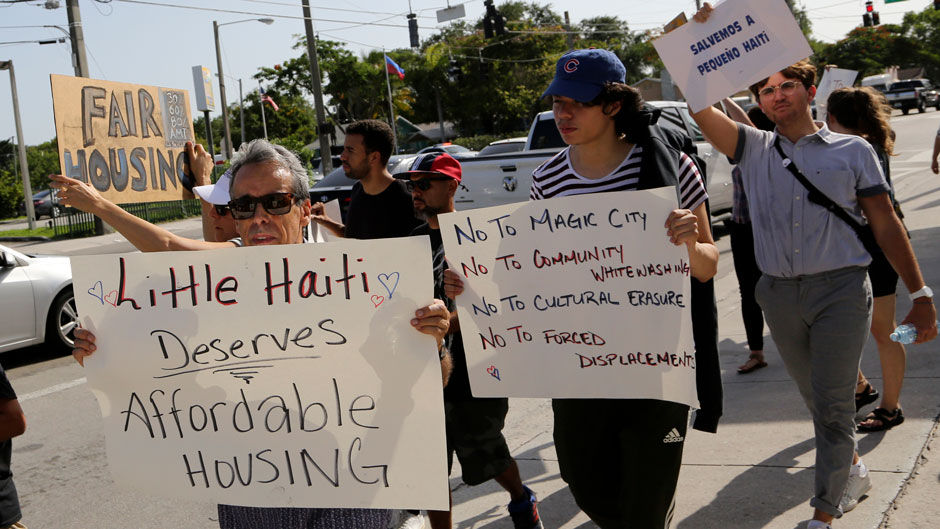
people leave climate risky areas to more environmentally resilient areas, prompting higher housing prices. Harvard scholar, Jesse Keenan, found that the rate of value appreciation of a Miami-Dade County single-family home is positively correlated to gradational measures of higher elevation. Based on these findings Keenan hypothesizes that the cost of living will continuously increase as households move from nuisance flood-prone areas like Miami Beach to neighborhoods like Liberty City and Little Haiti that are topographically elevated by a limestone ridge and safer from sea level rise (Keenan et al., 2018).
The increased cost of living and displacement happens as a result of another phenomenon, green gentrification (Anguelovski, 2017). As more public investment dollars are placed into transforming these once redlined neighborhoods, property values go up and long-standing residents are priced out.

Greening occurs when environmental planning is implemented to further increase resiliency through engineered infrastructure, planting trees for cooling, and creating more green space for water absorption. Investment in greening along with other new amenities for entertainment and better quality of life results in higher property taxes and is absorbed by the valuation of property/rent payers (Keenan et al., 2018). Low wages in Miami along with other generational, complex, socio-economic factors it is becoming impossible for historically Black and Brown communities to continue paying rent for housing and business properties.
The Future of Miami-Dade County
Unfortunately, these unintended consequences of climate change in MDC have only just begun. As the housing market continues to expand inland for the rich and diminish for the poor, the rate of displacement will continue to grow for the foreseeable future. Nonetheless, sea-level rise does not only affect barrier islands and the east coast but increasingly the westward municipalities of MDC as well. When South Florida gets heavy rainfall, canals receive and move excess water as part of the regional hydrologic and flood control system. With the increase in sea level rise some of the infrastructure, particularly structures in the coastal belt of the county are no longer working as designed. The system was designed for the water to flow by gravity. From higher elevated canals to bays and estuaries and eventually into the lower ocean levels. However, as the sea level rises, gravity will no longer do the job and the excess water has nowhere to go but up over seawalls and through drainage infrastructure (South Florida’s Rising Seas, 2014). Western communities are at just as much risk as we continue to see sunny-day flooding more and more all over the county and throughout the greater South Florida region. Water levels in Miami are predicted to increase at least 8 inches (best case scenario) or no more than 6.6 feet (worst case scenario) by 2100 (Parris, 2012). As the causal loop continues in the coming decades, more and more South Florida natives are predicted to relocate to Central and Northern Florida unless proper, long-term mitigation strategies and housing regulations are implemented to protect the most vulnerable communities.
Food, Energy, and Water Supply
As we look into the future, displacement is not the only consequence we face with sea-level rise. Saltwater intrusion is a growing threat to our food, water, and

energy supply. Intrusion happens when saltwater transfers into the freshwater aquifer. As the South Florida population grows, underground freshwater supplies are dwindling, which allows saltwater to osmotically enter through the porous limestone rock. As the sea level rises this osmosis will occur much faster, thrusting saltwater into freshwater aquifers and canals. Many Miami-Dade municipalities get water supply for residents from well fields drilled into the Biscayne aquifer which is near the coast. The concern is, that as sea level rises and saltwater pushes through the limestone, it will reach the wells very quickly posing a contamination threat to our drinking water and irrigation for agriculture (food supply). Even if the short-term solution to depleted farmland is importing most of our food, that is only going to create more carbon emissions, contributing to global warming further diminishing a chance for MDC to create a localized, sustainable agricultural/food system.
When we think of how energy is involved in climate change challenges, we usually see it as the cause and reason for climate change. Yet, energy sources can also be affected by climate change. One example of this in Miami-Dade County is FPL’s Turkey Point power plant (in Homestead). Executive director of Miami Waterkeeper, Dr. Rachel Silverstein, explains that safety concerns are rising due to the Nuclear Regulatory Committee (NRC) granting, “the world’s first 80-year operating license to Miami’s Turkey Point nuclear reactor – 40 years longer than the plant was ever meant to operate.” The 50-year-old cold war design along with growing environmental concerns makes this a safety issue for the over 3 million residents living less than 25 miles away (Silverstein, 2021). The Turkey Point reactor sits on the water’s edge of Biscayne Bay and for the past decade, its cooling system has been leaking into Miami's groundwater supply. Because of the contamination along with saltwater intrusion, the reactor has been having difficulty tapping into a reliable source of freshwater. Without freshwater, the incredibly hot reactor cannot properly cool itself. Severe water surge from catastrophic weather events (hurricanes) and increased flooding due to sea-level rise can cause a nuclear meltdown of the reactor and hydrogen explosions. This potential disaster could leave the population with no energy source, and radioactive contamination.

Conclusion
In summation, MDC faces many sustainability challenges from decades ago and into the future. As development continues and our population grows, more human lives are at risk of displacement due to stronger and more frequent natural disasters, heat, flooding, and degradation of food, energy, and clean water supply. As a South Florida native and current resident of MDC, I can tell you that these issues are extremely visible and felt in day-to-day life. Driving down Dixie Highway on any given day from North Miami Beach to Downtown you see all the empty lots, either waiting to be bought by developers or already under construction to become modern expensive condos or commerce infrastructure. You see new wealthy Caucasian residents slowly but surely replacing the Black and Brown folks that had formerly resided in areas like Little Haiti, Little River, Liberty City, Wynwood, Overtown, Little Havana, and West Coconut Grove. You see the growing houseless population suffering from heat exhaustion, hunger, and thirst, simultaneously being pushed out by police and growing corporate/high-income populations of Downtown, Brickell, and Miami Design District. You may have to pull over due to torrential rain and flooding waters that stay on the roads for days hoping your car is not damaged or even totaled.
Ultimately, Miami-Dade County requires that its constituents, all municipality, city, state, and federal governments, business owners, and investors, collaborate and regulate each other for a sustainable future. We need renewable food, energy, and water solutions that benefit all residents, the land, and the biodiversity of the region and beyond. Although there is validity in having a pessimistic outlook for years to come, an optimistic mindset of abundance can show us the opportunities in the challenges we face. A transformation that can provide a balance between economic, societal, and environmental principles of sustainability.

Bibliography
Couldrey, M.P., Gregory, J.M., Boeira Dias, F. et al. What causes the spread of model
projections of ocean dynamic sea-level change in response to greenhouse gas
forcing?. Clim Dyn 56, 155–187 (2021). https://doi.org/10.1007/s00382-02005471-4
Duncan, J., Bhat M., Jones, S., Palacios, J., Reese, C. Mana Contemporary.
(2021). Environmental Challenges and Opportunities in South Florida. Retrieved September 16, 2021, from https://www.manacontemporary.com/event/environmental-challenges-and-opportunities-in-south-florida/.
Pinto, Juliet and MacMillin, Kate, "[Documentary] South Florida's Rising Seas" (2014). Sea Level Rise Collection. 76. Retrieved September 17, 2021, from, https://digitalcommons.fiu.edu/sea_level_rise/76
Merriam-Webster. (n.d.). Gentrification. In Merriam-Webster.com dictionary. Retrieved September 17, 2021, from https://www.merriam-webster.com/dictionary/gentrification
Keenan, J. M., Hill, T., & Gumber, A. (2018). Climate gentrification: From theory to empiricism in Miami-Dade County, Florida. Environmental Research Letters, 13(5), 054001. https://doi.org/10.1088/1748-9326/aabb32
Parris, A., P. Bromirski, V. Burkett, D. Cayan, M. Culver, J. Hall, R. Horton, K. Knuuti,
R. Moss, J. Obeysekera, A. Sallenger, and J. Weiss. 2012. Global Sea Level Rise Scenarios for the US National Climate Assessment. NOAA Tech Memo OAR CPO-1. 37 pp. https://cpo.noaa.gov/sites/cpo/Reports/2012/NOAA_SLR_r3.pdf
Silverstein, R. (2021, August 24). Safety concerns at Turkey Point are rising, along with sea-level rise. Miami Herald. Retrieved September 18, 2021, from https://www.miamiherald.com/opinion/op-ed/article253692763.html.


Comments